
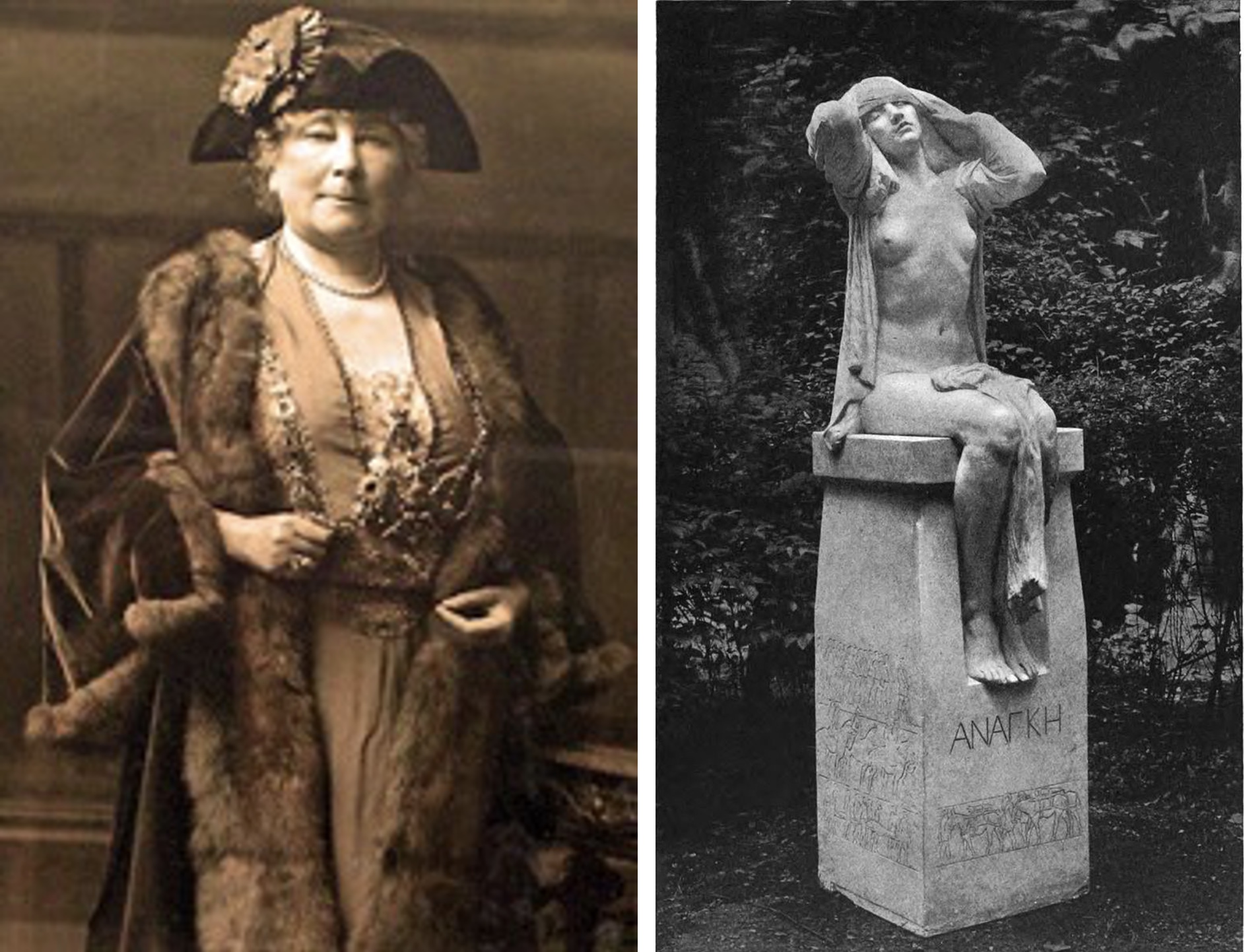
Dame Janet in her manorial robes and ‘Destiny’ when freshly carved in 1917 and before placement in Albion Gardens. Images in the public domain
There are over 100,000 memorials in Britain to the millions killed in the Great War but only one depicting a female figure and honouring all, including animals, who contributed to the war effort. Ramsgate’s monument, Destiny, is young, solitary, draped and mourning: she is Astarte, Mother of the Fates, goddess of war, sexuality, and healing – a pre-biblical goddess worshiped in the Middle East from the third millennium BC.
Sculpted in Portland Stone by Gilbert Bayes, the memorial was unveiled in 1920 by Dame Janet Stancomb-Wills, the first female Mayor of Ramsgate, to recognise not just servicemen but “all who served”, including animals.
Dame Janet inherited a fortune from her uncle Sir W H Wills, the first Baron Winterstoke, in 1911 and used the wealth generated from tobacco to benefit Ramsgate in a multiplicity of ways from public gardens to recreation grounds. land for new schools, a maternity ward and nurses’ home for the hospital, to ambulances and fire engines for a town depopulated and almost bankrupted by war.
The choice of Destiny for the memorial was a considered decision. New high explosives left few if any remains and destroyed the likelihood of identifying fatalities. Hope thrived on lack of evidence and for decades rumours of mistaken identity or lost memory persisted.
Campaigners for women’s right to vote had been active in the19th century but war saw armies of grieving, unsupported women forced into work, usually for low pay, often in vile conditions and without security, only to be brutally dismissed after the armistice when men returned from the armed forces. Against this background, a life-size naked female statue overlooking the Harbour was controversial. Even one dedicated to Peace was defaced and continued to be attacked at intervals for over a century.
Dame Janet moved to Ramsgate in 1911, but her world was not limited by geography. Her friend Sir Ernest Shackleton docked his ship Endurance at Ramsgate in 1913, and she agreed to support his Antarctic exploration – previously unsurveyed areas of the Weddell Sea became ‘Stancomb Wills Promontory and Stancomb Wills Glacier Tongue’ and when Endurance was entrapped by pack ice, the expedition escaped in its three open boats, one named the ‘Stancomb Wills’. She remained in touch with Shackleton until he died of a heart attack in 1922. Dame Janet, friend and confidante provided for his wife and children.
Also known Attartu, Astarte was goddess of the sea. Her statue in Albion Gardens overlooks a point where two tides that encircle Britain meet each day to overlap and merge: it is a seascape of awe and even veneration. In 1703, a Europe-wide cyclone led to the creation of Royal Harbour after 200 vessels and 2,000 lives were lost. The words “PERFUGIAM MISERIS” inscribed at the harbour mouth translate to “Refuge for those in need”, an inclusive gesture echoed by the words on the memorial commissioned by Dame Janet: “TO ALL WHO SERVED – HONOUR”
The British Legion’s 2025 Festival of Remembrance at the Royal Albert Hall featured former conscientious objectors as well as members of the LGBT community who had been forced from the Services. After 105 years it seems the UK is finally ready to embrace the inclusivity promoted by Dame Janet Stancomb-Wills and her memorial Destiny:
“THE GREAT WAR 1914-1918 TO ALL WHO SERVED – HONOUR”
Brian Daubney